


I recently came across a post from a wellness influencer making a pretty confident claim: rest will not help your high cortisol. Her prescription was a 10-step protocol involving saunas, cold plunges, an aggressive strength training regimen, and a list of supplements long enough to require its own spreadsheet.
By the time I finished reading it, I could feel my cortisol rising just from the guilt.
I have a full-time job, a child, a company I am building, and a genuine desire to sleep at night. I am not spending hours a day optimizing my stress hormones. And the idea that I need to in order to be healthy frankly stresses me out more than most of the things I am supposedly stressed about.
So I want to offer something different. Not a protocol. Not a product stack. Just the actual science of what raises cortisol in the first place, because I think it changes everything.
What cortisol actually is and why it rises
Cortisol is not the enemy. I want to start there.
It is a hormone produced by your adrenal glands, and it plays an important role in your body. It helps regulate your sleep-wake cycle, supports immune function, manages inflammation, and mobilizes energy when you need it. The problem is not cortisol itself. The problem is chronically elevated cortisol, which is what happens when your stress response stays switched on for too long without enough recovery.
So what triggers the spike?
Your cortisol rises because your amygdala, the threat-detection center of your brain, perceives danger. When it senses a threat, real or imagined, it sends a signal that kicks off a chain reaction: your HPA axis activates, cortisol gets released, and your body prepares to respond.
Here is the piece that most wellness content misses entirely.
The amygdala cannot distinguish between a real physical threat and a vividly imagined one. It fires the same alarm signal either way.
That means your cortisol responds identically to a tiger in the room and to a worst-case scenario you are running in your head at midnight. It responds the same way to a painful memory you keep replaying, a stressful email you are mentally composing before you have even opened your laptop, or forty-five minutes of doom scrolling through upsetting news before bed.
You can be horizontal on the couch and still be flooding your body with cortisol. And you can be sitting quietly doing nothing that looks like a biohacking protocol and genuinely lowering it, if your mind is actually at rest.
Rest is less about what you do than about what you think
This is the line I want you to sit with, because it reframes everything.
The wellness industry has a financial interest in making you feel like you are not doing enough. More protocols, more products, more performance, more guilt, and conveniently, more programs to fix all of it. But the fundamental driver of elevated cortisol is not a missing supplement or a skipped sauna session. It is a nervous system that does not feel safe.
And safety does not come from doing more. It comes from what is happening in your mind.
This is why I genuinely believe that practices like gratitude, prayer, real connection with people you trust, and consciously redirecting catastrophic thinking are not soft or secondary strategies. They are measurably cortisol-lowering activities. Not because they are magic, but because they interrupt the threat signal your amygdala is sending. They communicate safety to a nervous system that is stuck in alert mode.
This is also why "be anxious for nothing" is not just spiritual advice to me. It is physiological instruction. When you choose to redirect a spiraling thought, you are literally reducing the alarm signal that triggers cortisol release. That is biology, not wishful thinking.
What about the saunas and cold plunges?
I want to be fair here, because I am not interested in overcorrecting in the other direction.
Saunas, cold exposure, strength training, certain supplements, these things have genuine value. There is real research supporting their role in supporting stress resilience and overall health. I am not dismissing them.
But they are not the entry point. They are supporting actors, not the main character.
If your mind is stuck in a loop of threat and worry and catastrophic thinking, no amount of cold plunging is going to undo that. If you are doom scrolling for an hour before bed and then stepping into a sauna, you are working against yourself. The physical practices matter most when the mental and emotional foundation is already being tended to.
And here is the part that really got to me about that post I saw: by the time I finished reading it, I was more stressed than when I started. A piece of wellness content had raised my cortisol by making me feel inadequate about my cortisol levels. If that is not a perfect illustration of the problem, I do not know what is.
Anyone telling you that you need an exhausting, guilt-inducing protocol before you have even addressed what your mind is doing has missed the most fundamental piece of the puzzle.
What actually helps
I want to be practical here, because this is not just a critique. It is meant to point somewhere useful.
If you want to genuinely lower your cortisol, start with your mind. That does not mean toxic positivity or pretending stress does not exist. It means getting honest about what your brain is doing when you are supposedly at rest.
Are you actually resting? Or are you lying down while your mind runs a highlight reel of everything that could go wrong?
A few things that genuinely interrupt the threat signal:
Gratitude that is specific and felt, not performed. Naming three real things you are grateful for and actually sitting with them for a moment, not just listing them, shifts the brain's focus away from threat and toward safety.
Genuine connection. Time with people who feel safe to you is one of the most powerful cortisol regulators we have. Not social performance. Actual warmth and presence.
Prayer or contemplative quiet. For me personally, this is not separable from the rest. Bringing my mind to something steady, something larger than the current worry, is one of the most reliable ways I know to let my nervous system exhale.
Redirecting catastrophic thoughts before they spiral. Not suppressing them, but noticing them and choosing not to follow them all the way down.
These are not impressive-sounding interventions. They will not go viral. Nobody is going to sell you a program around them. But they address the actual mechanism. And that matters.
Daily physical support without the overwhelm
One place where I do believe in the physical side of cortisol support is in what you give your body consistently and daily, without adding to your stress load.
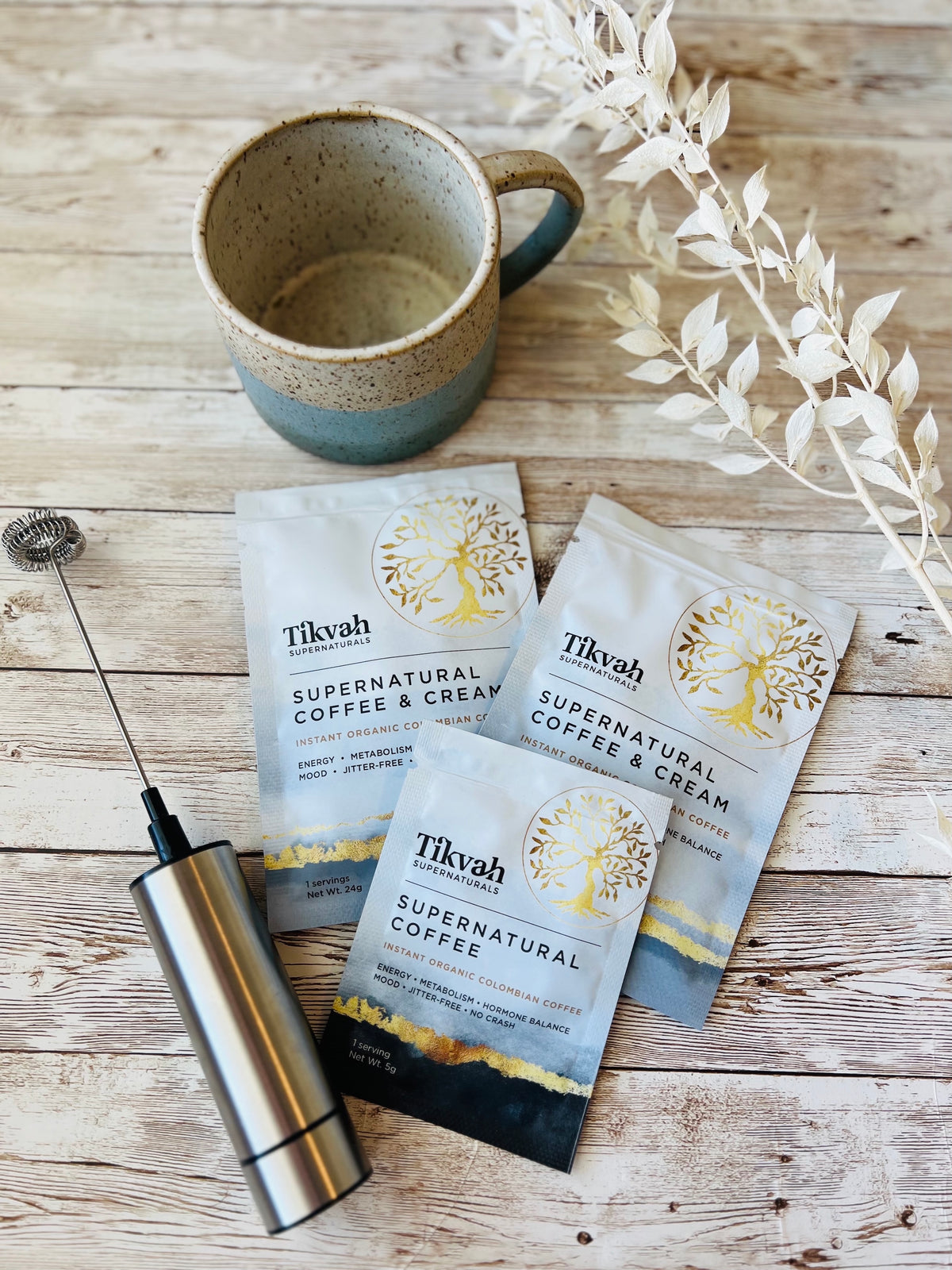
That is a core reason I created Tikvah Supernaturals. Not a 10-step protocol. Not a biohacking regimen that requires rearranging your life. Just a daily cup of mushroom coffee that combines organic coffee with adaptogens like reishi mushroom, rhodiola, and maca to help your body manage cortisol and sustain calm, steady energy through the day.
No spike. No crash. No guilt. Just consistent, quiet support for a nervous system that is already doing a lot.
Because your nervous system does not need more performance. It needs more safety. And the simplest things, done consistently, are usually where the real support lives.
Has wellness content ever made you feel more stressed about being stressed?