


There is a blueprint most of us were handed without realizing it.
It looks like a 9-to-5 schedule built around sustained, consistent output with no built-in recovery window. It looks like productivity measured in hours logged and tasks completed. It looks like rest being something you earn rather than something you need. It looks like pushing through discomfort as a sign of discipline, and slowing down as a sign of weakness.
That blueprint was designed around a male body. Male biology. A male hormonal cycle and a male stress response.
And women have been trying to keep up with it ever since.
For a while, most of us can. We are capable, driven, adaptable. We figure out how to perform in systems that were not built for us. We get good at it. And then somewhere in our 30s, 40s, or 50s, the body stops cooperating. The wall appears. The burnout comes and does not fully leave. The energy that used to come back after a good weekend no longer returns on schedule.
And the cruel part is that most women blame themselves for it.
What chronic stress actually does to a woman's body
Women and men both experience stress. But the way our bodies respond to it, and the long-term cost of chronic exposure to it, is not the same.
Here is the short version of what is happening biologically.
When your body registers stress, it activates the HPA axis, which stands for hypothalamic-pituitary-adrenal axis. This is the system that governs your stress response and cortisol production. Cortisol is not inherently bad. It is your body's way of mobilizing energy and alertness when you need it. The problem is what happens when it stays elevated for a long time.
Men have 10 to 20 times more testosterone than women. Testosterone blunts the cortisol response, which means it acts as a biological buffer against the full physiological impact of stress. A man and a woman can be in the same high-pressure environment, pulling the same hours, facing the same demands, and his biology is absorbing more of that hit. Hers is taking it full force.
Women also run on a 28 to 30 day hormonal cycle, not a 24-hour one. That cycle affects everything: energy levels, cognitive function, stress tolerance, emotional processing, metabolism, and recovery. Ignoring it does not make it irrelevant. It just means your body is absorbing the cost of being ignored.
And then there is the pregnenolone steal. When your body is in chronic stress mode, it pulls from a precursor hormone called pregnenolone to keep producing cortisol. Pregnenolone is also the building block for progesterone, which is the hormone that calms your nervous system and supports sleep and mood regulation. Less progesterone means more stress reactivity. More stress reactivity means more cortisol. The cycle feeds itself until something gives.
Usually, the thing that gives is you.
Why women hit walls in their 30s, 40s, and 50s
This is the part I want to spend a moment on, because I think it explains something a lot of women feel but cannot name.
In your 20s, your hormonal reserves are generally higher. Your body can absorb more and recover faster. The cost of running on stress, of saying yes to everything, of skipping rest, of treating your body as a machine, is lower in the short term.
But the tab is being added up.
By the time you hit your mid-30s and beyond, hormonal shifts are already happening naturally. Progesterone starts to decline earlier than estrogen does. Cortisol tolerance becomes lower. Recovery takes longer. The reserves your body was drawing from quietly for years are running thin.
And that is when the wall appears.
The exhaustion that does not lift after a good sleep. The weight that shows up around the middle and does not respond to the things that used to work. The anxiety that feels lower-level but constant. The sense of going through the motions while something underneath is running out.
This is not aging poorly. This is the predictable result of a body that has been running against its own biology for too long, with not enough support.
Burnout is not a character flaw
I want to say this clearly because I needed to hear it myself, and I suspect some of you do too.
Burnout is not laziness. It is not weakness. It is not what happens to women who cannot handle the same things everyone else can handle.
It is your body asking you, sometimes begging you, to finally pay attention.
For a lot of us, the narrative we internalized is that pushing through is strength and slowing down is failure. That taking care of yourself is indulgent. That asking for less is settling. That needing rest means you are not cut out for what you are trying to build.
None of that is true. All of it is costing you.
Strength that destroys your health is not strength worth keeping. And nourishing yourself, actually, genuinely nourishing yourself instead of just performing wellness, is not a soft option. It is the foundation everything else gets built on.
What stopping to nourish actually looks like
I am not going to give you a 10-step protocol. That is not what this is about.
What I will say is that it starts with listening. Most women I know, myself included, spent years overriding the signals their bodies were sending. Learning to actually hear them, and to believe they are worth responding to, is the first real shift.
It means building rest into your life as a non-negotiable, not as a reward you get when everything else is done. It means being honest about what you can actually carry versus what you have been forcing yourself to carry because it felt like what was expected. It means learning to work with your hormonal cycle instead of demanding the same output from yourself every single day of the month.
And it means supporting your body physically, consistently, in ways that work with your biology rather than against it.
Daily support that actually works with your body
This is where I want to mention something I genuinely believe in, because I created it out of my own need.
After my adrenal crash and the years of rebuilding that followed, I became very intentional about what I was putting into my body every day. I needed energy that did not spike my cortisol further. I needed support for my stress response that actually addressed the root rather than just masking the depletion. And I needed something easy enough to actually be consistent with.
That is Tikvah Supernaturals.
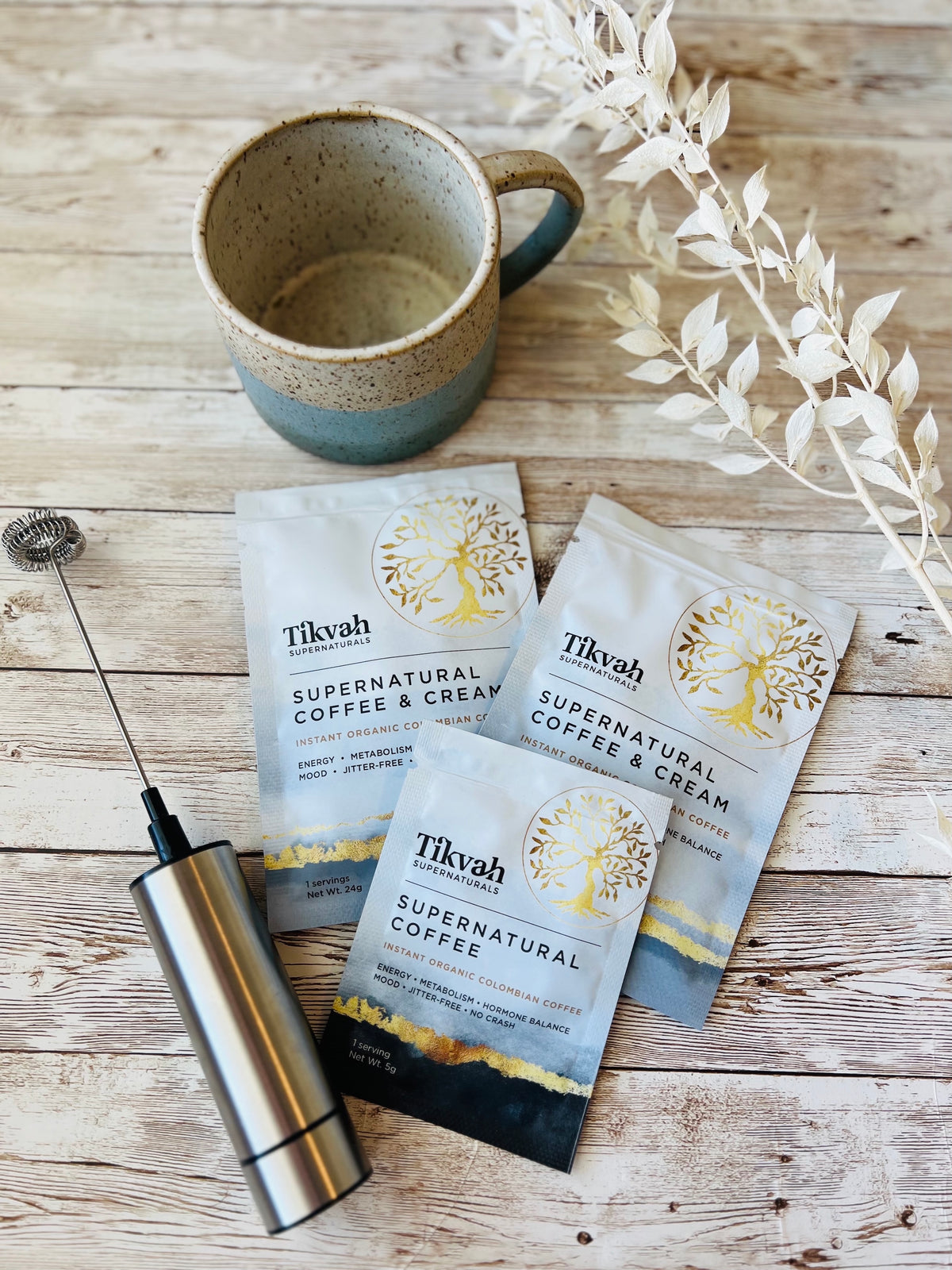
Our mushroom coffee blend combines organic coffee with adaptogens like reishi mushroom, rhodiola, and maca to support cortisol balance and give your body calm, steady energy through the day. No spike, no crash, no extra burden on already-taxed adrenals. It is the kind of daily support that builds with consistency, and it is something I reach for every morning without exception.
If you are a woman who is done pushing through and ready to actually nourish instead, this is a good place to start.
The blueprint we were handed was not made for us. But we do not have to keep following it.
Your body is not the problem. The system that ignored it is. And you are allowed to build something different now.