


I want to share something that would have saved me years of frustration if I had understood it sooner.
No supplement, no healthy diet, no wellness routine is going to work the way you need it to if your body is living in fight or flight.
That is not a knock on any of those things. They matter. But they have a ceiling. And that ceiling is your nervous system.
Why you can do everything right and still feel wrong
Most people who are serious about their health are doing a lot of the right things. Eating well. Prioritizing quality sleep. Taking the supplements. Exercising consistently. Reading the articles and listening to the podcasts and genuinely trying.
And yet a lot of those same people still feel off. Still tired. Still hormonally out of balance. Still carrying weight that does not respond to what they are eating. Still anxious in a low-grade, hard-to-name way.
The piece that is almost always missing from the conversation is chronic stress.
Not the dramatic, obvious kind. The quiet kind. The kind that has just become the background noise of daily life. The constant low hum of too much to do, not enough recovery, a nervous system that never fully gets to come down.
When your body is in that state, it does not matter how clean your diet is. It cannot overcome the level of stress being placed on it every single day.
What fight or flight actually does to your body
Your body's stress response is a brilliant system. When you are in genuine danger, it kicks into action fast. Cortisol and adrenaline flood your system, your heart rate goes up, your senses sharpen, your body mobilizes everything it has toward immediate survival.
And then, when the danger passes, it is supposed to come back down. The threat is gone, the alarm signal quiets, and your body returns to its baseline. That is how the system is designed to work.
The problem is that in modern life, for a lot of us, the alarm never fully quiets.
Work pressure, financial stress, relationship tension, the endless scroll of news and social media, the mental load of managing a household and a career and everything in between. Your amygdala, the part of your brain that detects threat, cannot always tell the difference between a real physical danger and a stressful email you are dreading. It fires the same signal either way.
So the cortisol keeps getting produced. And the body stays in a low-grade version of fight or flight even when nothing acute is happening.
The hormone conversation nobody is having
Here is where it gets especially relevant for women.
When your body is constantly focused on producing cortisol, it has to pull resources from somewhere to do that. The precursor hormone it uses is called pregnenolone.
Pregnenolone is also the building block for your sex hormones, including estrogen and progesterone. So when your body is dedicating most of its pregnenolone to cortisol production because the stress signal is always on, the hormones your body depends on for balance, mood, sleep, libido, and reproductive health end up getting less of what they need.
This is sometimes called the pregnenolone steal. And it explains why chronic stress does not just make you tired. It can disrupt your entire hormonal picture. Which then affects how you feel physically, emotionally, and mentally in ways that can be very hard to trace back to stress if no one has ever connected those dots for you.
You can take all the hormone-supporting supplements in the world. But if the stress signal is still running underneath everything, your body cannot fully use what you are giving it.
The body was never meant to stay in survival mode
This is the part I come back to again and again, because I think it is the most important reframe.
Your body is not broken. It is doing exactly what it is designed to do under the conditions it is being given. Fight or flight is a brilliant survival response. It is just not meant to be a permanent state.
When it becomes permanent, or close to it, the body cannot prioritize the things that are not immediately about survival. Digestion slows. Repair processes get pushed to the back. Immune function becomes less efficient. Hormonal balance takes a back seat. Sleep quality suffers. The things that make you feel well, vibrant, and like yourself get deprioritized because the body is too busy trying to keep you alive in a threat environment that never actually ends.
The most important question is not what supplement you should add. It is what conditions you need to create so your body actually feels safe enough to heal.
What actually helps
I want to be clear that this is not an argument against supplements or healthy eating or any of the other things you are probably already doing. Those things have real value. But they are most effective when the foundation underneath them is addressed.
The foundation is nervous system regulation.
That means creating genuine moments of safety in your day. Not just being still while your mind is still racing, but actually giving your body evidence that the threat is gone and it is allowed to come down. The practices that do this are often quieter and less impressive-looking than a supplement stack. Prayer and genuine connection. Choosing to redirect a spiraling thought rather than following it all the way down. Protecting your sleep in a way that is actually about sleep, not just hours in bed. Getting outside. Breathing deliberately. Saying no to things that drain you without a good return.
None of that is flashy. But it addresses the root in a way that adding more products simply cannot.
Daily support that works with your body, not against it
With all of that said, I do believe in giving your body consistent physical support. Not to override stress, but to help your system function better within it while you are doing the deeper work.
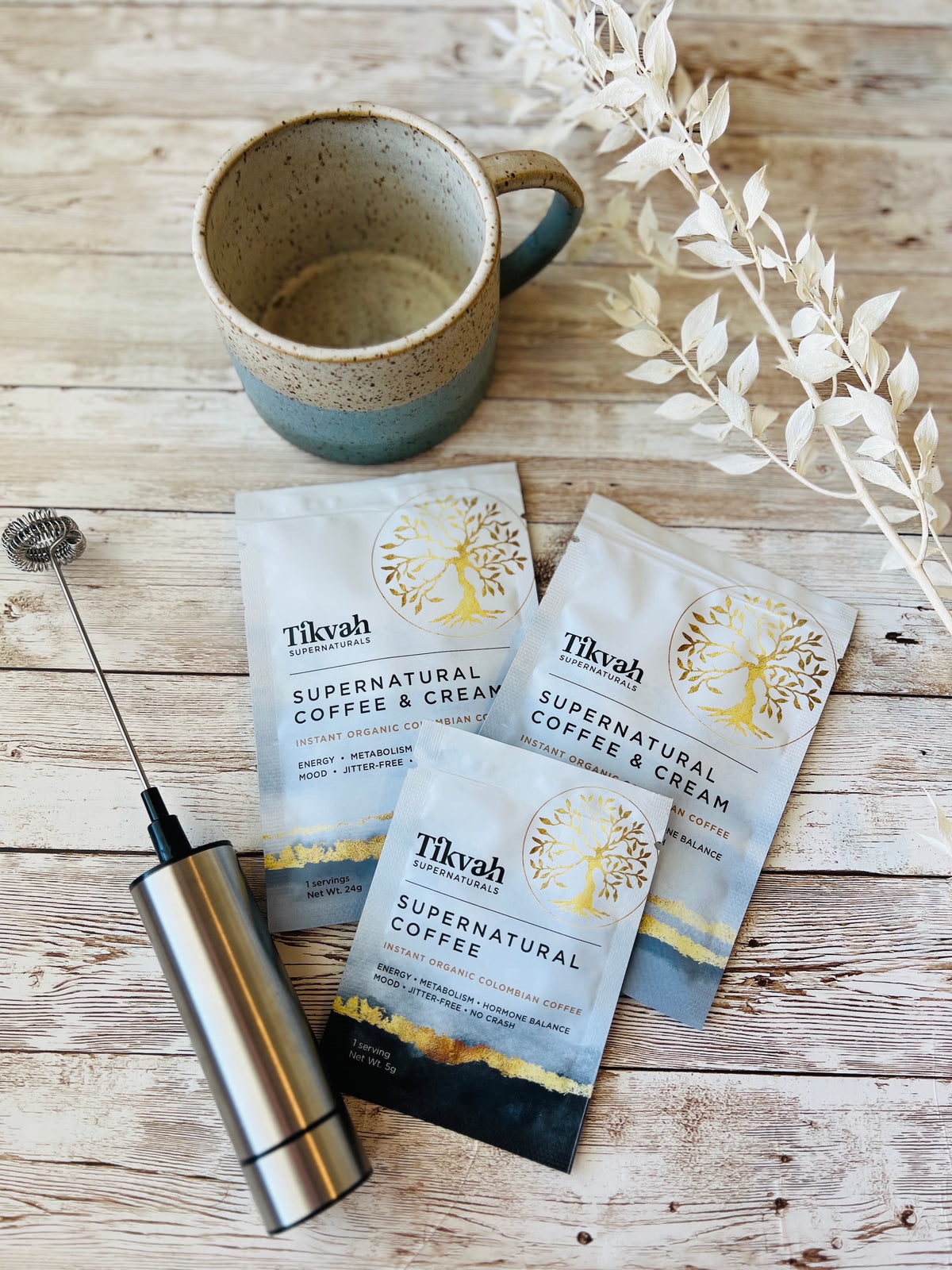
What set our mushroom coffee apart for me when I was creating it is the adaptogen piece. Adaptogens do not stimulate your body the way caffeine alone does. They help your body adapt to stress, supporting the HPA axis and helping to modulate cortisol rather than spike it further. Reishi mushroom, rhodiola, and maca were chosen specifically for this. Combined with organic coffee, you get real energy that works with your stress response instead of adding to the load it is already carrying.
It is not a fix for chronic stress. Nothing is, except actually addressing the chronic stress. But it is daily support that does not demand more from a body that is already stretched.
What if the answer you have been looking for is not another thing to add, but finally giving your body the space to recover?
That question changed everything for me. I hope it opens something for you too.