


I want to tell you something I have not always talked about openly.
For a long time, anxiety was just part of how I moved through life. Not the kind that shows up in a crisis and then leaves. The kind that quietly hums underneath everything. The low-grade, constant kind that makes you feel like you are always bracing for something, even when things look fine on the outside.
I was anxious about money. About work. About whether relationships would hold or fall apart. And in my mind, the story I kept telling myself was the same one: if those things would just stabilize, if life would just cooperate, I would finally be okay.
I had it completely backwards.
The belief I did not know I was holding
There was a season where I had a mentor who asked me a question that stopped me cold. It was something along the lines of: what do you believe about this situation?
Not what do you think about it. Not how do you feel about it. What do you believe?
I had never really separated those things out before. I just assumed my anxiety was a logical response to my circumstances. The job was uncertain. Money was tight. Life felt precarious. Of course I was anxious.
But my mentor helped me see something I had been completely blind to. My circumstances were not the source of my anxiety. My beliefs about my circumstances were.
I believed that safety was outside of me. That I could only be okay once external things aligned. That I had very little actual agency over my own life. And as long as I held those beliefs, no improvement in my circumstances was ever going to be enough. Because there would always be something new to be anxious about.
What belief work actually looks like
When people hear "examine your beliefs," it can sound like therapy jargon or abstract self-help talk. But in practice, it is much more concrete than that.
For me, it started with getting honest about the stories I was running on. Not the ones I would say out loud, but the ones underneath. The operating system, so to speak.
Things like: I am not safe unless I am in control. Or, something will always go wrong eventually. Or, I have to figure everything out myself.
Once you name them, you can question them. And when you start questioning them, the grip they have on your nervous system begins to loosen.
This is not positive thinking. It is not telling yourself everything is fine when it is not. It is more like forensic work. You are looking at a belief and asking, is this actually true? Where did this come from? Is it serving me or is it costing me?
And a lot of the time, you find that a belief you have been carrying for decades is not even yours. It came from a parent, or a painful experience, or a conclusion a much younger version of you drew when she did not have all the information.
The shift that changed everything
My life did not dramatically transform overnight. I want to be honest about that because I think the "overnight epiphany" narrative does more harm than good.
What happened was more gradual. I started noticing when a fear response would come up and instead of immediately reacting to it, I would get curious about it. What belief is underneath this? What am I actually afraid of here?
Over time, that practice built something. A little more steadiness. A little more trust in myself. A growing sense that I was not actually as powerless as I had believed.
And then something interesting happened. The external circumstances did start to shift. Not because I had somehow magically attracted better ones. But because I was showing up differently. Making different choices. Responding instead of reacting. Trusting myself to handle things rather than trying to control everything in advance.
My life changed because I changed first.
That is the whole secret. I know it sounds almost too simple. But the most true things usually do.
Why anxiety is also a body conversation
One piece I would be leaving out if I did not mention it: anxiety is not only a mental or emotional experience. It lives in your body too.
When I was in my most anxious season, my cortisol was chronically elevated. My nervous system was stuck in a low-grade fight-or-flight state. And what I know now, having spent years learning about adrenal health and stress physiology, is that you cannot fully think your way out of a dysregulated nervous system. You have to also address what is happening physically.
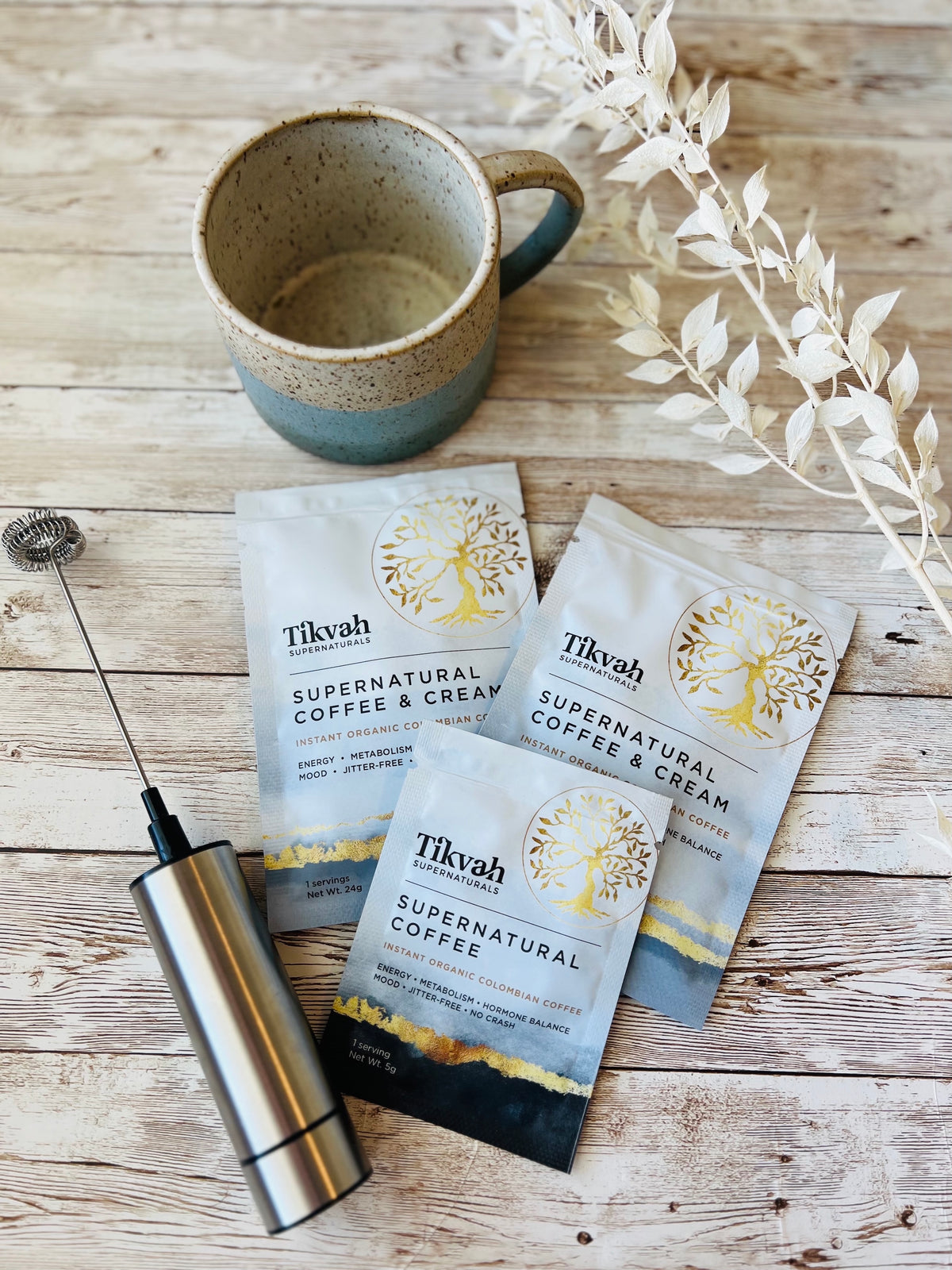
This is part of why I created Tikvah Supernatural. After my own health crash and the years of recovery that followed, I wanted something that would support my body's stress response without making things worse. Most energy products spike cortisol and leave you more depleted than before.
Our mushroom coffee blend works differently. The adaptogens, things like reishi mushroom, rhodiola, and maca, work with your body to support cortisol balance and give you steady, calm energy without the crash or the cortisol spike. It is something I drink every single morning, and it has stayed a part of my routine for a reason.
If you are doing the inner work but your body feels like it is still stuck in survival mode, I genuinely think it can help. Consistency is where the benefit builds, and it is easy to make part of your day.